
5 Ways AI Helps Stabilize the Grid as Renewable Energy Grows
Solar and wind power don’t generate electricity at a constant, predictable rate — output depends on sunlight and wind conditions, which change hour to hour. Keeping the power grid stable while relying more heavily on these sources is a real technical challenge, and AI is increasingly the tool used to manage it. Here are five specific ways AI supports grid stability as renewable energy adoption grows.
1. Predicting Energy Demand in Real Time
One of the core challenges in grid management is matching supply to demand. Generate too much, and energy goes to waste. Generate too little, and the grid risks outages. AI models analyze historical patterns — weather, temperature, time of day — to forecast demand and update those forecasts continuously as conditions change. On a hot day, for example, rising air-conditioning use is a predictable pattern the grid can plan for in advance rather than reacting to after the fact.
2. Making Renewable Sources More Reliable
Solar and wind are clean but inherently variable. AI helps smooth this out by forecasting sunlight and wind conditions hours in advance, adjusting how much power is drawn from renewable sources accordingly, and switching to backup sources quickly when conditions shift — for example, when cloud cover reduces solar output unexpectedly. Done well, this keeps the transition between sources invisible to end users.
3. Catching Problems Before They Cause Outages
Grid infrastructure fails in ways that often show early warning signs — unusual vibration in equipment, a developing fault, an at-risk line. Sensors distributed across the grid feed data continuously to AI systems that watch for these anomalies and flag them before they escalate into a larger outage. This shifts maintenance from reactive (fixing a failure after it happens) to predictive (catching it beforehand).
4. Balancing Energy Across Regions
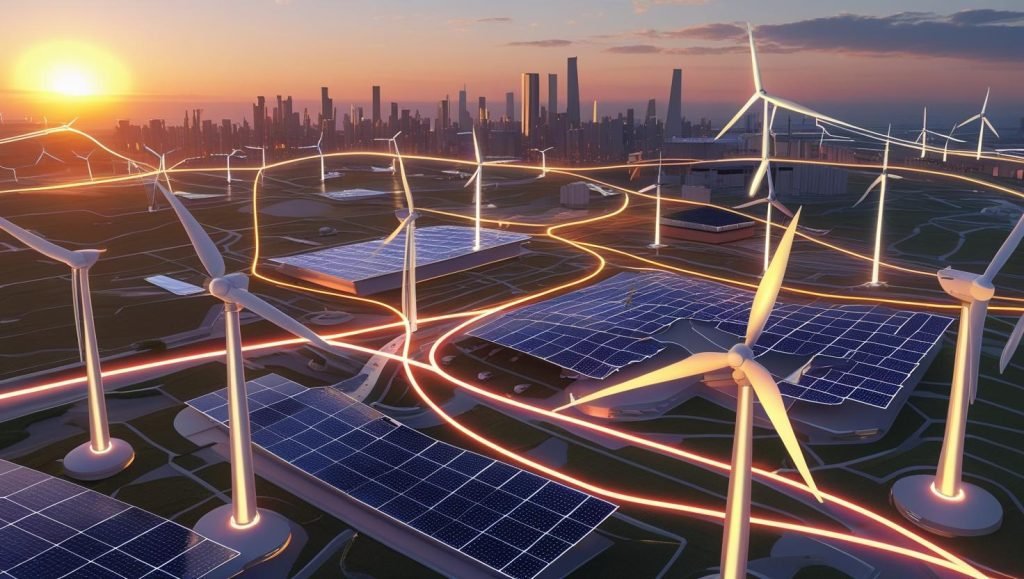
Renewable generation is often uneven across regions — one area may generate a surplus while a nearby area falls short. AI systems continuously assess supply and demand across the network and route power to where it’s needed, doing this fast enough to respond to real-time shifts in wind and solar output. This reduces waste and keeps regional supply more consistent.
5. Optimizing Battery Storage
Excess renewable energy is often stored in batteries for use when generation drops — at night, or during low-wind periods. AI improves how these batteries are used by choosing optimal charge and discharge timing, avoiding overcharging or excessive depletion, and managing flow in a way that extends the battery’s usable lifespan. Better-managed storage reduces reliance on fossil-fuel backup and helps prevent power interruptions.
Why This Matters Beyond the Grid
The underlying pattern here — sensors feeding continuous data to a system that predicts and responds in real time — shows up across industrial settings well beyond power grids. Our piece on using industrial IoT to cut factory downtime covers the same predictive-monitoring approach applied to manufacturing equipment.
Frequently Asked Questions
Why is grid stability harder with renewable energy?
Renewable sources like solar and wind generate power at variable rates depending on weather conditions, unlike traditional plants that can produce a steady, predictable output.
Does AI replace human grid operators?
No — AI handles the real-time prediction and monitoring at a scale humans can’t match manually, but operators still oversee the system and respond to the alerts AI surfaces.
How does battery storage fit into grid stability?
Batteries store excess renewable generation for use when output drops, and AI-optimized charging and discharging makes that stored energy more reliable and longer-lasting.
The Bigger Picture
As renewable energy becomes a larger share of the grid, the variability that comes with it needs to be managed somehow — and AI’s ability to predict, monitor, and respond in real time is what makes that manageable at scale, rather than something grid operators handle through manual adjustment alone.