
IoT Protocols: 7 Best Options Compared for 2026 Projects

Ask five engineers which of the IoT protocols is best, and you will get six answers.
That is not because they are confused. It is because the question is incomplete. IoT protocols do different jobs, and comparing MQTT to LoRaWAN is a bit like comparing a courier to a road.
Here is the plain version. This guide compares seven widely used IoT protocols, shows what each is good at, and flags where the claims come from the vendors themselves. At IoT Insights Hub, we would rather you pick a protocol you can test than one that merely sounds modern.
What are IoT protocols, and why do they matter?
IoT protocols are the agreed rules that let devices send data to each other and to the cloud. They matter because the wrong choice drains batteries, drops messages or locks you into one vendor. The right choice fits your range, power budget and data size.
New to the basics? Start with our guide on what IoT is, in a simple beginner guide. Then come back here to choose between the IoT protocols below. IoT Insights Hub keeps the basics guide and this comparison side by side.
Think of two layers of IoT protocols. The first is messaging, meaning how a message is written and delivered. MQTT, CoAP and HTTP live here. The second is the link, meaning how bits travel through the air. LoRaWAN, NB-IoT, Zigbee and Bluetooth LE live here.
A real project usually picks one from each layer of IoT protocols. A sensor may talk Bluetooth LE to a gateway, and the gateway may speak MQTT to the cloud. Our piece on multi-protocol IoT systems covers that mix.
How do the 7 best IoT protocols compare?
MQTT, CoAP and HTTP handle messaging, while LoRaWAN, NB-IoT, Zigbee and Bluetooth LE handle the wireless link. MQTT suits live telemetry, CoAP suits tiny devices, LoRaWAN and NB-IoT suit wide areas, and Zigbee and Bluetooth LE suit short range. The table shows each one’s best fit.
| Protocol | Layer | How it works | Best for |
|---|---|---|---|
| MQTT | Messaging | Publish/subscribe through a broker, usually over TCP/IP | Live telemetry to the cloud |
| CoAP | Messaging | Request/response over UDP, with optional reliability | Very small devices, lossy networks |
| HTTP | Messaging | Standard web request/response | Web apps and APIs |
| LoRaWAN | Radio link | Star-of-stars network of gateways | Wide-area, low-power sensors |
| NB-IoT | Radio link | Low-power wide-area service on mobile networks | Rural and deep indoor coverage |
| Zigbee | Radio link | Self-healing mesh, 2.4 GHz and Sub-GHz | Smart homes and buildings |
| Bluetooth LE | Radio link | Point-to-point, broadcast or mesh in 2.4 GHz | Phones, wearables, short range |
Sources: OASIS (MQTT v5.0), IETF RFC 7252 (CoAP), LoRa Alliance, GSMA, Connectivity Standards Alliance (Zigbee) and Bluetooth SIG. The “best for” column is our editorial judgement.
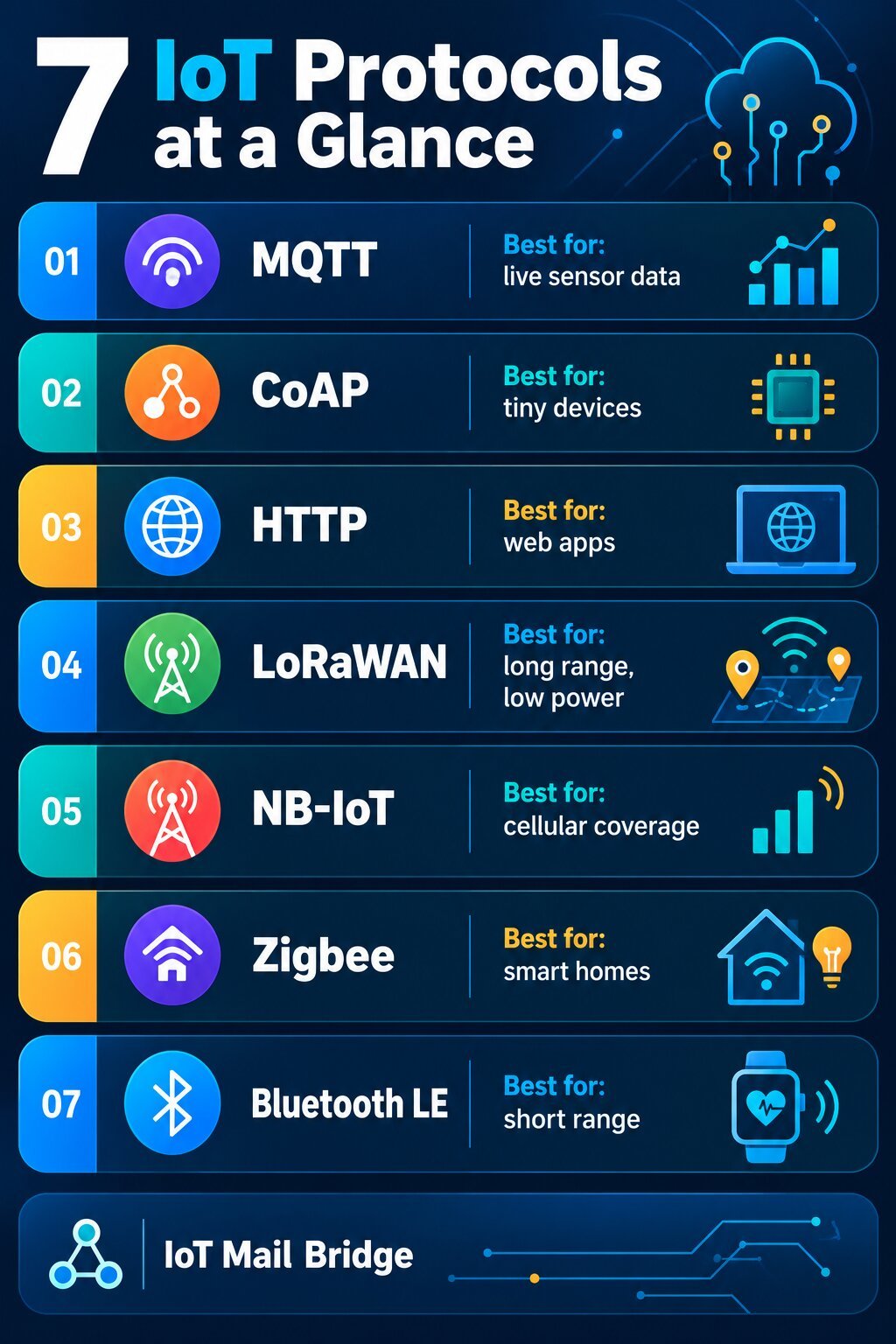
Which IoT protocols should you use for messaging: MQTT, CoAP or HTTP?
Use MQTT for steady telemetry to a cloud broker, CoAP for very small devices on unreliable networks, and HTTP when your devices talk to existing web apps and APIs. MQTT and CoAP are built for constrained devices. HTTP is heavier but familiar to every developer.
1. MQTT
MQTT is a client-server publish/subscribe protocol, per the OASIS specification. It normally runs over TCP/IP and has three delivery levels: at most once, at least once and exactly once. The current OASIS Standard, version 5.0, is dated 7 March 2019.
Devices publish to a broker, and other clients subscribe. That makes it neat for many sensors feeding one dashboard. Read what MQTT is and how it works for a full walkthrough.
2. CoAP
CoAP is defined in RFC 7252 (June 2014) as “a specialized web transfer protocol for use with constrained nodes and constrained (e.g., low-power, lossy) networks.” It runs over UDP and uses DTLS for security, per the RFC.
The RFC notes such nodes often have 8-bit microcontrollers with small amounts of ROM and RAM. If your device is that small, CoAP deserves a look.
3. HTTP
HTTP is the web’s own request/response protocol. Every developer knows it, and every cloud supports it. It carries more overhead than MQTT or CoAP, so it suits devices with power and bandwidth to spare. See our notes on APIs for IoT device connectivity.
Whatever you pick, think about what happens to the data next. At IoT Mail Bridge, the team writes about how machine messages turn into alerts. Their guides on a reliable SMTP relay for IoT and M2M fleet alerts and how to set up IoT email automation the right way cover that last mile.
Which IoT protocols suit long range or short range: LoRaWAN, NB-IoT, Zigbee or Bluetooth LE?
LoRaWAN and NB-IoT suit wide areas and low power, while Zigbee and Bluetooth LE suit homes, buildings and short range. LoRaWAN uses your own gateways, and NB-IoT uses a mobile network. Zigbee builds a mesh, and Bluetooth LE connects easily to phones.
4. LoRaWAN
Per the LoRa Alliance, LoRaWAN uses a star-of-stars topology, where gateways relay messages between devices and a central network server. The Alliance claims up to 15 km range in rural areas and 10+ years of battery use. Those are its own claims, without test conditions. For real examples, read LoRaWAN explained with 7 real-world uses.
5. NB-IoT
GSMA describes NB-IoT as a standards-based low power wide area technology with extended coverage for rural and deep indoor locations. It says battery life of more than 10 years can be supported for a wide range of use cases, and that it can co-exist with 2G, 3G and 4G networks.
For a closer look, see how NB-IoT cuts energy in smart devices, and five reasons NB-IoT is the future of smart connectivity on IoT Mail Bridge. Rural connectivity is a real hurdle, too. The Business Perspective notes low-connectivity rural areas as a challenge in its report on Mitti Labs’ $9.5M Series A.
6. Zigbee
The Connectivity Standards Alliance calls Zigbee a self-healing mesh that is scalable to thousands of nodes, optimised for low power. It supports both 2.4 GHz and Sub-GHz bands. The Alliance says over a billion Zigbee devices have been deployed worldwide.
7. Bluetooth LE
Per the Bluetooth SIG, Bluetooth LE is designed for very low power operation. It uses 40 channels in the 2.4 GHz band and supports point-to-point, broadcast and mesh topologies. Data rates run from 125 kb/s to 2 Mb/s. The SIG says over five billion Bluetooth products ship each year. For a power-focused view, read top IoT protocols to save power.
How do you choose between IoT protocols for your project?
Start with the job: how far the data travels, how long the battery must last and how much data you send. Then choose one messaging protocol and one radio link, and test both on site. Ask who runs the network, what it costs monthly and how you secure each device.
- Measure range. A few metres points to Bluetooth LE or Zigbee. Kilometres point to LoRaWAN or NB-IoT.
- Check power. A battery that must last years rules out chatty protocols.
- Size the data. Tiny readings suit CoAP or MQTT. Rich payloads can use HTTP.
- Decide who owns the network. LoRaWAN lets you run gateways. NB-IoT relies on an operator.
- Plan security early. Authenticate every device and encrypt traffic.
For security, read IoT security risks and how to fix them and edge to cloud data security for IoT fleets. For design trade-offs, see IoT architecture and interoperability challenges, and for site readiness, the checklist for deploying industrial IoT sensors.
Once messages flow through your chosen IoT protocols, the next risk is noise. Too many alerts and people stop reading them, which IoT alert fatigue explains well. A good twin of your data helps too, as shown in these digital twin examples. For where mobile networks are heading, read about 5G and IoT.
What do critics say about IoT protocols?
Critics say alliance figures for range and battery life are marketing claims, that fragmentation raises integration costs, and that no protocol fixes poor security. Supporters say open standards let you swap vendors. Both are right, which is why you should test on your own site.
What the careful voices say
- Claims are not tests. The 15 km and 10-year figures come from the groups that promote the technologies, with no test conditions given.
- Fragmentation costs money. Mixing protocols needs gateways and translation, which adds points of failure.
- Security is on you. A standard offers features, but weak passwords and old firmware still cause trouble.
- Vendor pitches need scrutiny. The Business Perspective’s analysis of AI wrapper versus deep tech startups is a useful lens when a platform promises to hide all this complexity.
What supporters say
- Open standards reduce lock-in. MQTT is an OASIS standard and CoAP is an IETF standard, so many vendors support them.
- Scale is proven. The Bluetooth SIG and the Connectivity Standards Alliance report billions of devices shipped or deployed.
Our view at IoT Insights Hub: when comparing IoT protocols, pick open standards where you can, and treat every headline number as a starting question.
What are the most common questions about IoT protocols?
People mostly ask what IoT protocols are, which is best, how MQTT differs from CoAP, whether LoRaWAN beats NB-IoT and how secure they are. IoT Insights Hub answers six common questions below, each with a clear limit or named source.
What are IoT protocols?
IoT protocols are the agreed rules that let connected devices send data to each other and to the cloud. Some, like MQTT, CoAP and HTTP, shape the messages. Others, like LoRaWAN, NB-IoT, Zigbee and Bluetooth LE, shape the wireless link. Most real projects combine one of each.
Which IoT protocol is best?
No single protocol wins everywhere. MQTT suits live telemetry to a cloud broker, CoAP suits tiny devices, and HTTP suits web apps. For the radio link, LoRaWAN and NB-IoT suit wide areas, while Zigbee and Bluetooth LE suit short range. Match the protocol to range, power and data size.
What is the difference between MQTT and CoAP?
MQTT is a publish/subscribe protocol that normally runs over TCP and uses a central broker. CoAP is a request/response protocol built for constrained devices and runs over UDP. MQTT suits steady data streams to the cloud, while CoAP suits very small devices on lossy networks.
Is LoRaWAN better than NB-IoT?
Neither is better in general. LoRaWAN lets you run your own gateways, while NB-IoT rides on a mobile operator’s network. The choice depends on coverage, running costs and control. Check actual signal at your site, and compare quotes, before you commit to one.
Are IoT protocols secure?
Security depends on how a protocol is set up, not just which one you pick. CoAP binds to DTLS, and LoRaWAN and NB-IoT include encryption features. Even so, weak passwords, old firmware and open brokers cause most problems. Encrypt traffic, authenticate every device and patch regularly.
Can one project use more than one IoT protocol?
Yes, and most do. A common set-up uses Bluetooth LE or Zigbee inside a building, a gateway to collect data, and MQTT to send it to the cloud. Plan the gateway carefully, because it translates between protocols and often becomes the busiest and most important device.
What is the bottom line on IoT protocols?
There is no single best protocol. Pick one messaging protocol and one radio link that fit your range, power and data size, and test them on site. IoT Insights Hub will keep updating this guide as standards change.
Go back to those five engineers. They were all right. The best of the IoT protocols is the one that suits your range, battery and budget.
Take the comparison table to your next design review, shortlist two options and test both. If you sell IoT products and need to reach buyers, ARS B2B Social Bridge can help with outreach. For more guides, browse IoT in agriculture and the rest of IoT Insights Hub.