
When to Use Edge Computing: 7 Critical Signs You Need It Now
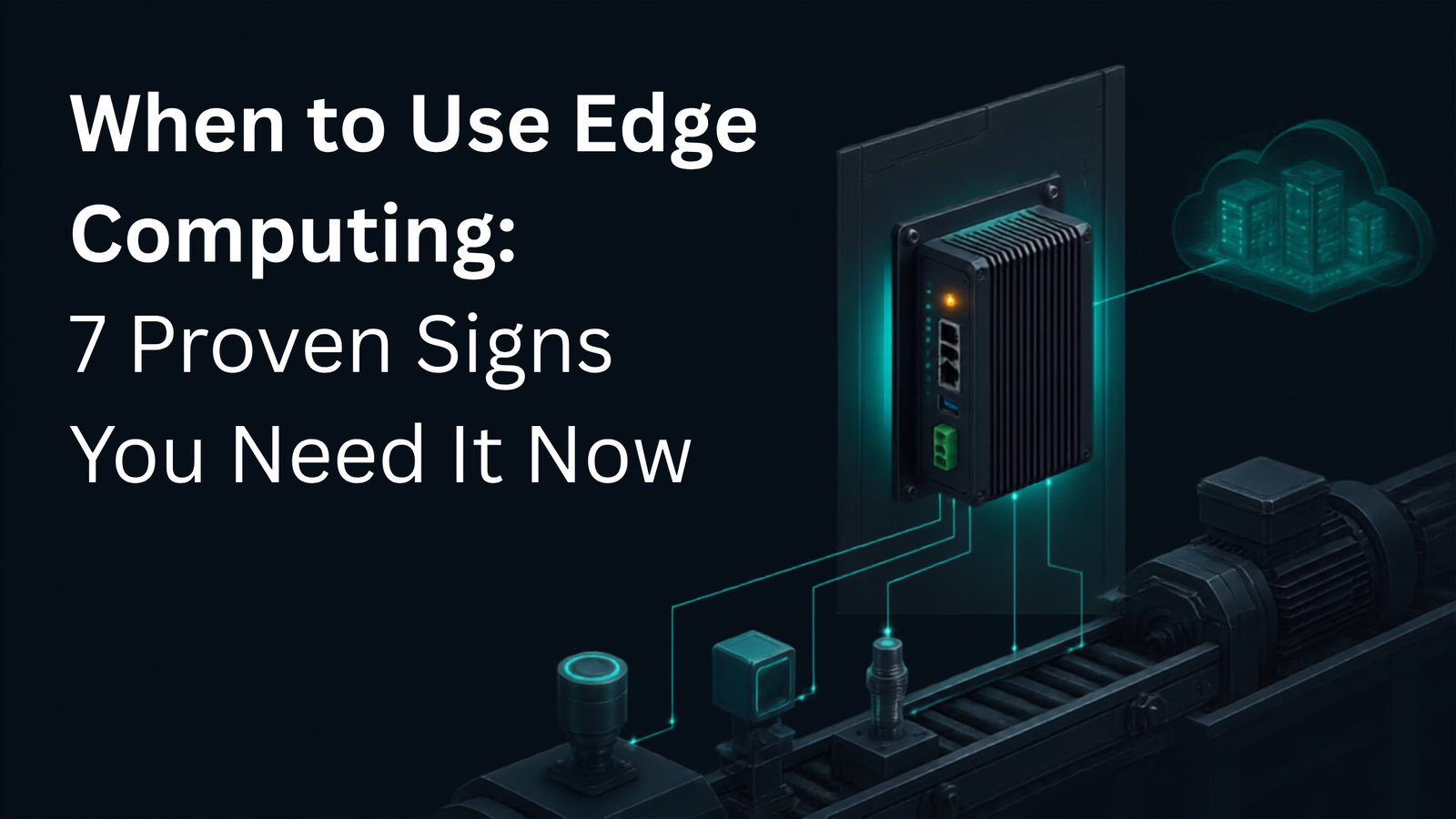
Knowing when to use edge computing comes down to one question: does your data lose its value in the time it takes to reach the cloud? If your system needs responses under 100 milliseconds, produces more data than your bandwidth budget can carry, must keep running during network outages, or handles data that legally cannot leave a site — process it locally. Everything else is usually cheaper in the cloud. According to Gartner, by 2025 more than 75% of enterprise-generated data will be created and processed outside a traditional centralised data centre — the window for deciding when to use edge computing is now, not later.
- Understanding when to use edge computing pays off fastest on latency, bandwidth and uptime problems — not on compute cost alone.
- If you discard more than 90% of the data you upload, you are funding a bandwidth problem you can solve locally.
- Regulated data, offline-critical sites and video or vibration workloads are the clearest cases for going local.
- Most mature deployments end up hybrid: edge for reaction, cloud for learning and long-term storage.
- The question of when to use edge computing is a timing question as much as a technical one — moving too early buys complexity you do not need yet.
Every IoT team eventually hits the same wall. The pilot worked beautifully with fifty devices. Then the rollout crosses a few thousand nodes, the cloud bill triples, and somebody in the finance meeting asks why you are paying to upload data that gets discarded within seconds of arriving.
That is the moment the question stops being academic. Knowing exactly when to use edge computing is the difference between a deployment that scales and one that quietly gets cancelled in its second year.
At IoT Mail Bridge, we track this question across dozens of real deployments. This guide skips the theory. Below are the 7 critical signals we look for before recommending a local processing layer, the situations where the cloud honestly still wins, and a five-question test you can run against your own architecture this week.
What edge computing actually means in an IoT system
When to use edge computing depends first on understanding what it means: moving processing away from a central data centre and placing it on or beside the device that generates the data — so decisions happen locally, in milliseconds, without a cloud round-trip.
In practice that could be a smart camera running inference on its own chip, a gateway in an electrical panel filtering sensor readings, or a small server in a plant room. The cloud does not disappear. It changes role — from doing every calculation to receiving results, training models and storing history.
The useful mental model is simple: the edge handles reaction. The cloud handles reflection. Once you have that split clear, the question of when to use edge computing becomes much easier to answer for any given workload.
The 7 critical signs it is time to move processing to the edge
You need to understand when to use edge computing by recognising 7 operational signals: sub-100ms latency requirements, bandwidth costs rising faster than device count, sites that must run offline, data residency regulations, high data discard rates, battery-constrained remote sensors, and video or vibration workloads that break cloud-first architectures.
1. Your latency budget is under 100 milliseconds
A round trip to a regional cloud region typically costs 50 to 150 milliseconds before your code even runs. If a robotic arm has to stop, a valve has to close, or a safety system has to trigger inside that window, the decision has to be made locally.
This is the single most common reason teams first ask when to use edge computing, and it is rarely negotiable once a safety case is attached to it.
2. Bandwidth costs are climbing faster than your device count
Watch the ratio, not the absolute figure. If adding 20% more sensors adds 40% to your connectivity spend, your architecture is uploading raw data where it should be uploading conclusions. A vibration sensor sampling at 10 kHz produces enormous volumes of data. The event you actually care about is one line: bearing anomaly detected, confidence 0.94.
This is one of the clearest indicators of when to use edge computing at the network layer — when bandwidth scales faster than value delivered.
3. The site cannot stop working when connectivity drops
Rural agriculture sites, mines, ships, remote pump stations and older factory floors all share one trait — connectivity is not guaranteed. A cloud-dependent design turns a two-hour link failure into a two-hour production halt.
Local processing lets the system keep making decisions and sync later, which is often the entire business case on its own. If your site has intermittent connectivity, you already know when to use edge computing — the answer is now.
4. Data residency rules block raw uploads
Healthcare imaging, employee video footage, and increasingly Indian industrial data under sectoral guidelines cannot always leave the premises in raw form. Local processing solves this elegantly.
You run inference on site, upload only anonymised metadata, and your compliance conversation becomes far shorter. This is one of the clearest regulatory signals for when to use edge computing — when the law decides for you.
5. You are paying to process data you immediately discard
Audit one week of ingest. In most deployments the IoT Mail Bridge team reviews, more than 95% of uploaded readings are unremarkable and are dropped after aggregation.
Filtering at source turns that into a rounding error. This is where the cost saving is genuinely large rather than theoretical — and a strong signal of exactly when to use edge computing for cost-driven deployments.
6. Devices run on battery in places nobody wants to visit
Radio transmission is usually the biggest power draw in a battery-powered sensor — far bigger than local computation on a modern low-power chip. Sending one summary per hour instead of a reading per second can stretch a deployment from months to years.
Every avoided site visit is real money saved, and this power constraint is a reliable indicator of when to use edge computing for remote or rural sensor deployments.
7. Your workload is video, audio or high-frequency vibration
These three data types break cloud-first architectures faster than anything else. If your use case involves quality inspection, people counting, acoustic monitoring or predictive maintenance, assume you will need local inference and design for it from day one rather than retrofitting it after the pilot.
When the cloud is still the better choice
Understanding when to use edge computing also means knowing when not to. Keep work central when training or retraining models, correlating data across many sites, when your workload is genuinely occasional, or when your fleet is small enough that gateway hardware costs more than the bandwidth it would save.
Being honest about the limits matters, because forcing a local processing layer into the wrong project is an expensive mistake. Keep the work central when you are training or retraining models, when you need to correlate data across many sites, when your workload is genuinely occasional, or when your fleet is small enough that gateway hardware and on-site maintenance cost more than the bandwidth you would save.
There is also a hidden operational cost people underestimate. Every edge node is a device you must patch, monitor and update over the air. Fifty gateways spread across three states is a fleet management problem, not just an architecture choice. If you do not have a plan for firmware updates, you are not ready to distribute your processing yet.
Not all IoT architects agree that latency is the primary signal for when to use edge computing. A growing school of thought — including analysts from McKinsey’s 2025 Connected Operations report — argues that the strongest business case for edge computing is cost-driven rather than latency-driven for most industrial deployments. In their view, the bandwidth cost curve, not the millisecond response window, is what creates the clearest ROI in years two and three. For the majority of agriculture, utilities, and logistics deployments where a one-second response is perfectly acceptable, the financial case is stronger than the technical one. Both framings are valid — the honest answer is that the right signal depends entirely on your specific use case.
Edge computing vs cloud computing: a practical comparison
The comparison below shows the key trade-offs that determine when to use edge computing vs keeping workloads central. Edge wins on response time, offline operation and bandwidth cost at scale. Cloud wins on upfront cost, model training and centralised management.
| Factor | Edge computing | Cloud computing |
|---|---|---|
| Typical response time | 1 to 20 milliseconds | 50 to 300 milliseconds |
| Works offline | Yes | No |
| Bandwidth usage | Low — sends conclusions | High — sends raw data |
| Upfront cost | Higher — hardware per site | Lower — pay as you grow |
| Cost at scale | Flattens out | Grows with data volume |
| Model training | Impractical | Ideal |
| Maintenance burden | Distributed fleet to manage | Centrally managed |
| Best for | Real-time control, offline sites, regulated data | Analytics, training, multi-site correlation |
The five-question test before you commit
Run this test with your engineering and finance leads together. Three or more yes answers means the case for local processing is strong, and you have a clear answer on when to use edge computing for your specific deployment.
Run this with your engineering and finance leads in the same room. Three or more yes answers means the case for local processing is strong.
- Does a delay of 200 milliseconds cause a real operational or safety problem?
- Is more than 90% of the data you upload discarded without ever being queried?
- Would a connectivity outage of one hour stop work at the site?
- Are you legally restricted from moving this data off the premises in raw form?
- Will your connectivity spend exceed the cost of gateway hardware within eighteen months?
If you answered yes to only one or two, stay cloud-first and revisit the question after your next scaling milestone. Deciding when to use edge computing is a timing question as much as a technical one, and moving too early buys complexity you do not need yet.
A realistic recommendation
Most teams that answer the question of when to use edge computing correctly run a hybrid split — keeping time-critical logic at the edge and pushing summaries upward for analytics, dashboards and model improvement. Start by instrumenting what you already have for 30 days, then decide.
Most teams that get this right do not choose a side. They run a hybrid split, keeping time-critical logic at the edge and pushing summaries upward for analytics, dashboards and model improvement. Start by instrumenting what you already have.
Measure your actual latency, your discard ratio and your bandwidth trend for thirty days. Those three numbers will answer the question of when to use edge computing far better than any vendor comparison chart or consultant recommendation.
If you want to go deeper on the security side, the IoT Mail Bridge guide on Edge-to-Cloud Data Security for IoT Fleets covers exactly how to protect data once you have distributed your processing layer — and why security architecture needs to change when you move from cloud-only to hybrid.
Frequently asked questions about edge computing
These are the questions the IoT Mail Bridge editorial team hears most often when readers are evaluating when to use edge computing for their own deployments.
Is edge computing cheaper than cloud computing?
Not at first. It has a higher upfront hardware cost per site but a flatter cost curve as data volume grows. It becomes cheaper once bandwidth and ingest fees exceed the cost of local gateways — for most industrial fleets, that crossover happens somewhere between twelve and twenty-four months, which is exactly when to use edge computing becomes the financially obvious choice.
Can edge computing and cloud computing work together?
Yes, and that is the normal pattern in mature deployments. The edge handles real-time detection and control, while the cloud stores history, trains models and serves reporting. The two layers exchange summaries rather than raw streams. This hybrid approach is how most teams resolve the question of when to use edge computing — by doing both.
What are the main disadvantages of edge computing?
Higher upfront hardware cost, a distributed fleet that needs patching and over-the-air updates, limited local compute for heavy models, and a larger physical attack surface. These are manageable — but they need a plan before rollout rather than after. These operational costs are part of honestly evaluating when to use edge computing vs staying cloud-first.
How much bandwidth does edge processing actually save?
Filtering at source commonly cuts upstream traffic by 90 to 99% for sensor telemetry (per IDC). Video workloads see the largest reduction, since a detection event is a few kilobytes compared with a continuous stream measured in megabits per second. This bandwidth saving is one of the most compelling arguments for when to use edge computing in high-data-volume environments.
When to use edge computing vs keeping everything in the cloud?
Use local processing when you need sub-100ms responses, when connectivity is unreliable, when data residency rules apply, when you are discarding more than 90% of uploaded data, or when you are running video or high-frequency sensor workloads. Stay cloud-first when your fleet is small, your workload is infrequent, or you need cross-site model training. These are the clearest signals for when to use edge computing and when not to.
Read More: Edge-to-Cloud Data Security for IoT Fleets · 5 Reasons NB-IoT Is the Future of Smart Connectivity · Predictive Maintenance Using Machine Learning