
Digital Twin Examples: 7 Real Uses in Factories and Cities
Imagine a plant manager near Pune asking a simple question: what if we could break the line without actually breaking it?
He is a made-up character, but the question is real. Digital twin examples answer it by giving a machine, a factory or even a city a live virtual copy. You test the risky idea on the copy first.
Here is the thing, though. Plenty of articles list twins without saying who built them, when or what they saved. This guide sticks to examples we could check against a named source, and it tells you where the evidence runs thin.
At IoT Mail Bridge, we write about the sensor and alert side of IoT every day. That is exactly what keeps a twin honest.
What are digital twin examples, and what makes something a twin?
A digital twin is a virtual model of a real machine, building or place that keeps updating from live data. The link to the real asset is the key. Without it, you only have a simulation. Real digital twin examples range from jet engines to whole cities.
NASA is widely credited with the idea, mirroring spacecraft on Earth. Today, factories, hospitals, farms and city offices use it. If you want the basics first, read our guide on digital twin examples that start with IoT sensors, and for wider background see digital twin technology and smart operations.
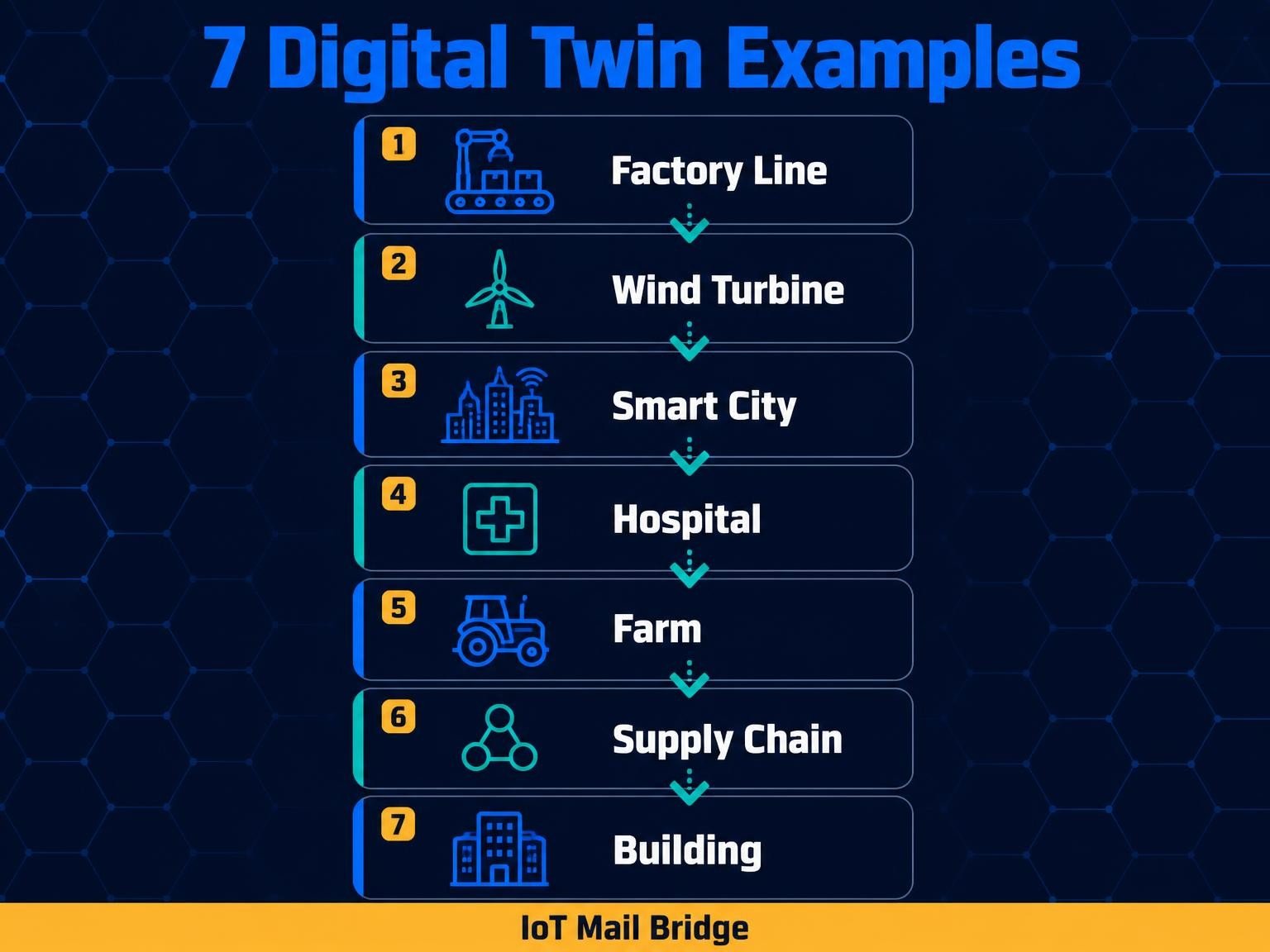
Use the table below as a shortlist of digital twin examples to copy, then read the detail under each one.
The seven digital twin examples below are the ones we could trace to a named company, agency or study. Dates are shown, because a 2019 result is not a 2026 result.
| Example | Sector | What it models | Reported result |
|---|---|---|---|
| BMW Debrecen | Automotive | A whole factory, planned virtually | Virtual production started 2+ years before launch |
| Unilever | Consumer goods | Plant production and energy use | About $2.8M saved at one site (2019) |
| Rolls-Royce | Aerospace | Each engine individually | Up to 50% longer maintenance intervals on some engines |
| Virtual Singapore | City | The island in 3D with live data | Tool for solar, flood, planning tests |
| Helsinki | City | The city as a 3D model | Used for planning, solar, flood and noise checks |
| Mater Private | Hospital | Radiology department workflow | Layout redesigned; no figures published |
| Spanish tomato farm | Agriculture | Irrigation on 15 hectares | 140 t/ha in 2023 on 413 mm of water |
Which digital twin examples show up in factories?
BMW and Unilever are the clearest factory digital twin examples. BMW planned and validated its Debrecen plant entirely virtually. Unilever built virtual copies of plants and reported about $2.8 million saved at one Brazilian site. Both show the twin working before or beside real production.
Example 1: BMW plans a whole factory virtually
BMW Group said on 21 March 2023 that Debrecen would be its first plant planned and validated entirely virtually. Vehicle production was already running in the virtual plant more than two years before series production, per BMW.
Behind it sits NVIDIA Omniverse. Since November 2020, BMW has scanned more than 7 million square metres of indoor and 15 million of outdoor production space, per the same release. Planning tools such as Siemens Process Simulate and Dassault CATIA feed into one shared model.
At IoT Mail Bridge, we read the release twice looking for numbers. What BMW did not give us is a savings figure. It says the approach makes planning faster and cheaper, with no percentage attached.
Example 2: Unilever builds virtual copies of its plants
Per a July 2019 report in SDCExec, which cites the Wall Street Journal, Unilever worked with Microsoft to build digital twins from machine data such as temperature and motor speed. It had eight twins at that time, with data streaming from 15 sites.
A virtual factory in Brazil saved about $2.8 million through lower energy use and higher productivity, per the same report. That is a 2019 figure, so treat it as a proof of concept. For the sensor groundwork, see our checklist for deploying industrial IoT sensors.
More on plant-floor gains is in our benefits of digital twin IoT for manufacturers, and the wider picture sits in manufacturing IoT from IoT Insights Hub.
How does Rolls-Royce use a digital twin for jet engines?
Rolls-Royce tracks each engine as an individual using flight data, then tailors maintenance to it. Per CIO.com in 2021, each flight generates about half a gigabyte of data, and for some engines the time between maintenance was extended by up to 50%. These are company-reported figures.
Example 3: Rolls-Royce treats every engine as one-of-a-kind
Stuart Hughes, then chief information and digital officer, described it as “truly variable service looking at each engine as an individual engine.” The company monitors how, where and under what conditions each engine flies.
The same CIO.com piece says one airline avoided about 85 million kg of fuel since 2014. These are Rolls-Royce claims, and we found no independent audit of them.
The lesson from these digital twin examples for smaller plants is simple. One twin per critical asset beats one giant model. Our guide on how predictive maintenance uses machine learning shows how that works, and the predictive maintenance guide gives the basics.
What are the best digital twin examples in cities?
Virtual Singapore and Helsinki are the best-known city digital twin examples. Both are detailed 3D models used to test ideas before building, such as solar power, flooding, noise and planning impact. Singapore’s was led by its National Research Foundation, while Helsinki’s runs on Bentley software. IoT Mail Bridge treats both as the benchmark for city digital twin examples.
Example 4: Virtual Singapore
Per Singapore’s GovTech (March 2017), Virtual Singapore is a 3D model of the island led by the National Research Foundation. The Singapore Land Authority supplied map data and Dassault Systemes worked on the platform.
Planned uses included finding rooftops for solar panels, modelling floods, simulating pollution and noise, and checking how a new stadium or highway would affect traffic. It could even pick the safest cycling route, which may not be the shortest.
Example 5: Helsinki’s citywide twin
Engineering.com reported in June 2022 that Helsinki built its model with Bentley tools. It supports solar power analysis, flood checks, noise calculations and planning. Permit information sits in the model, and the city opens its data to residents and developers.
Kalasatama served as a pilot area. The city also has a net-zero carbon goal for 2035, and analysis of green infrastructure supports it, per the same report. For broader context, read how smart cities use tech for better urban living and smart cities and better communities.
Are there digital twin examples in hospitals and farms?
Yes. Mater Private Hospital in Ireland used a Siemens Healthineers workflow twin to redesign its radiology department. A research team in Spain used an irrigation twin, Irri_DesK, on a 15-hectare commercial tomato plot. Both are smaller, more practical digital twin examples than cities or jet engines.
Example 6: A hospital radiology department
Per Siemens Healthineers, Mater Private used a digital twin for workflow simulation to cut waits and disruption. Staff tested layout changes on the model before touching the real department.
The case study gives no figures, so we cannot tell you how much it saved. It still shows a practical use: test the floor plan on screen. See IoT in healthcare and smarter hospitals for related uses.
Example 7: A tomato farm in Spain
A study by IRTA researchers, published in Agronomy (MDPI) on 5 September 2025, tested Irri_DesK on 15 hectares in Extremadura across 2023 and 2024. It combines soil moisture sensors, climate data and simulation to set daily irrigation.
In 2023 the plot gave 140 tonnes per hectare using 413 mm of water. In 2024 it gave 126 tonnes. The abstract does not state a percentage water saving against the other methods, so we do not claim one. Read more in IoT in agriculture.
How do you start a small digital twin pilot?
Pick one critical machine or process, add any missing sensors, and build a twin of that alone. Run it beside the real asset for several weeks and compare predictions with reality. Measure one number, such as downtime, before and after. Only then add more assets or sites.
Every one of the digital twin examples above started small. IoT Mail Bridge suggests the same path for you.
- Choose one asset where a failure or delay is costly.
- Check your data. Missing or noisy sensor data sinks twins fast.
- Build the smallest useful twin, not a model of the whole plant.
- Run it in parallel and log where it differs from reality.
- Decide the alert path before it goes live.
That last step gets skipped. A twin that spots a fault nobody reads has saved nothing. Our notes on IoT alert fatigue and a reliable SMTP relay for IoT fleet alerts cover delivery, and cutting factory downtime with industrial IoT covers the cost side.
What do critics say about digital twin examples?
Critics say many digital twin results are self-reported, old or missing numbers altogether. Twins also need good data and skilled people, which smaller plants may lack. Supporters say testing changes on a copy is cheaper than testing on the real asset. Both views hold, so measure your own pilot.
What the careful voices say
- Numbers are self-reported. Rolls-Royce, Unilever and others published their own figures, and we found no independent audit.
- Some results are missing. BMW gave no savings percentage, and the Mater Private case study gives no figures.
- Digital twin examples age quickly. The Unilever figure is from 2019 and the Singapore details from 2017.
- Vendor claims need scrutiny. Ask what sits under the hood before buying. The Business Perspective’s piece on AI wrapper versus deep tech startups is a good lens for that.
What supporters say
- Testing on a copy is cheaper. BMW’s virtual production started before series production of the real plant.
- The compute is getting easier to find. Platforms such as Omniverse run on NVIDIA hardware, and the money behind that is covered by The Business Perspective in the SpaceX and Nvidia AI chip deal.
Our view at IoT Mail Bridge: digital twin examples are real, but the best results come from small, well-measured pilots.
What are the most common questions about digital twins?
People mostly ask for real examples, how twins differ from simulations, what they cost, whether small plants can use them and whether results are proven. IoT Mail Bridge answers six common questions below, each with a clear limit or a named source.
What are some real digital twin examples?
Real examples include BMW’s virtual Debrecen plant, Unilever’s factory twins, Rolls-Royce engine monitoring, Virtual Singapore, Helsinki’s city model, a hospital radiology simulation at Mater Private and an irrigation twin on a tomato farm in Spain. Each one models a physical asset using live or scanned data.
What is the difference between a digital twin and a simulation?
A simulation tests a design once, using assumed inputs. A digital twin stays linked to the real asset through sensor data, so it keeps updating as conditions change. That live link lets teams spot drift, predict faults and test changes against today’s real state, not a fixed model.
How much does a digital twin cost?
Costs vary widely and no single price fits. They depend on sensor count, software platform, data integration and skilled staff. A small pilot on one machine costs far less than a city-wide model. Ask vendors for a fixed-scope pilot quote and measure one result, such as downtime, before scaling.
Can small factories use a digital twin?
Yes, if they start small. Pick one critical machine or line, add the sensors it lacks, and build a twin of that alone. Small plants often gain most from predictive maintenance twins. Avoid trying to model the whole factory first, because data gaps and cost grow fast.
What data does a digital twin need?
It needs a reliable stream from the real asset: sensor readings such as temperature, vibration or flow, plus design data and maintenance history. For cities, it also needs 3D scans and map data. Poor or patchy data is the most common reason twins disappoint.
Are digital twin results independently proven?
Often not. Many figures come from the companies using the twins, and some projects publish no savings at all. BMW, for instance, gave no savings percentage for its Debrecen twin. Treat headline numbers as claims, ask for the method behind them, and measure your own pilot.
What is the bottom line on digital twin examples?
Digital twin examples prove the idea works, from factories and engines to cities, hospitals and farms. They also show gaps in published results. Start with one asset, measure one number, and build the alert path early. IoT Mail Bridge will keep tracking real projects.
Go back to the plant manager and his question. He does not need a model of the whole factory. He needs one good twin of the one machine that keeps him awake.
Take these digital twin examples to your next planning meeting, pick one asset and measure honestly. If you sell IoT or industrial software and need to reach plant decision-makers, ARS B2B Social Bridge can help with outreach. For more on sensors and automation, browse IoT Insights Hub.
One thought on “Digital Twin Examples: 7 Real Uses in Factories and Cities”