
Industrial AI Agents: 5 Proven Shifts for Factories in 2026
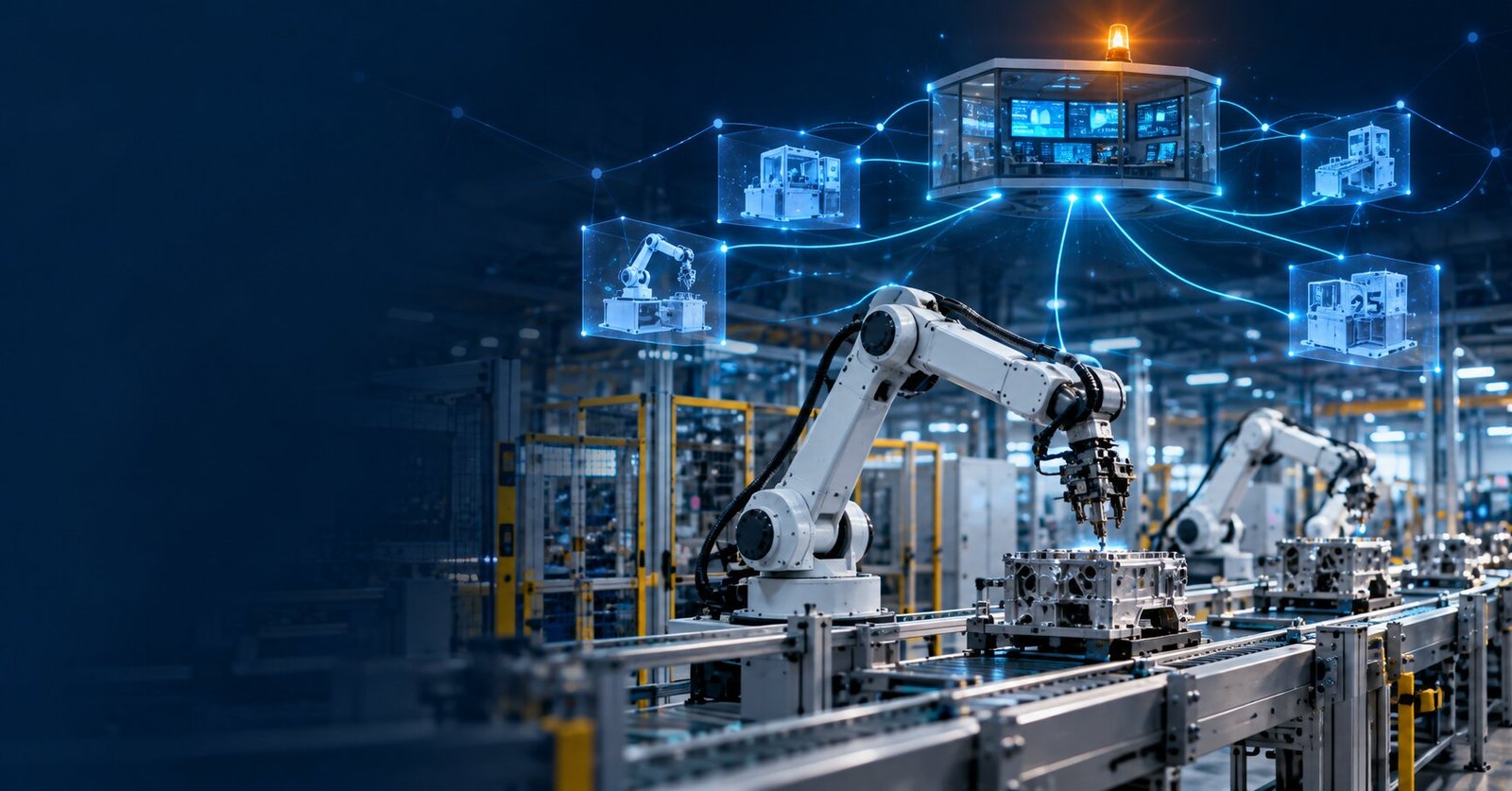
It is 2 am in a plant on the outskirts of Pune. A pump on line three starts running hot.
In the old way, a sensor sends one number, a dashboard turns amber, and nobody looks until the morning shift. By then the bearing is already gone.
Now imagine software that sees the same number, reads the maintenance history, raises the work order and asks the supervisor one question: approve the repair, yes or no. That is the promise of industrial AI agents. The plant in this story is made up, but the products behind it are real.
Here is the thing, though. The sales decks are tidier than the shop floor.
Per Crunchbase News, AI startups raised $102 billion in Q3 2026, which is 64% of all venture funding, as covered in The Business Perspective’s Q3 2026 venture funding analysis. But a well-funded idea is not a proven one.
At IoT Mail Bridge, we read the launch notes so you do not have to. This guide separates what has shipped from what is still a slide, and shows you how to test it safely.
What are industrial AI agents, and how are they different from copilots?
Industrial AI agents are software programs that do tasks in a plant on their own, like raising a work order or sending an alert. A copilot only answers questions and suggests. An agent acts, inside limits people set. That changes how you test, approve and switch it off.
Siemens explains the split clearly. The copilot is the screen you talk to, and the agents are the workers behind it. Rainer Brehm, CEO of Factory Automation at Siemens Digital Industries, said: “…we’re moving beyond the question-answer paradigm to create systems that can independently execute complete industrial workflows.”
Siemens also says users pick which tasks to hand over. A wrong suggestion costs an engineer a few minutes, but a wrong action can stop a line.
If your data side is weak, start there. Our guide on how predictive maintenance uses machine learning to catch equipment failures early covers the groundwork every agent needs.
Which companies have launched industrial AI agents so far?
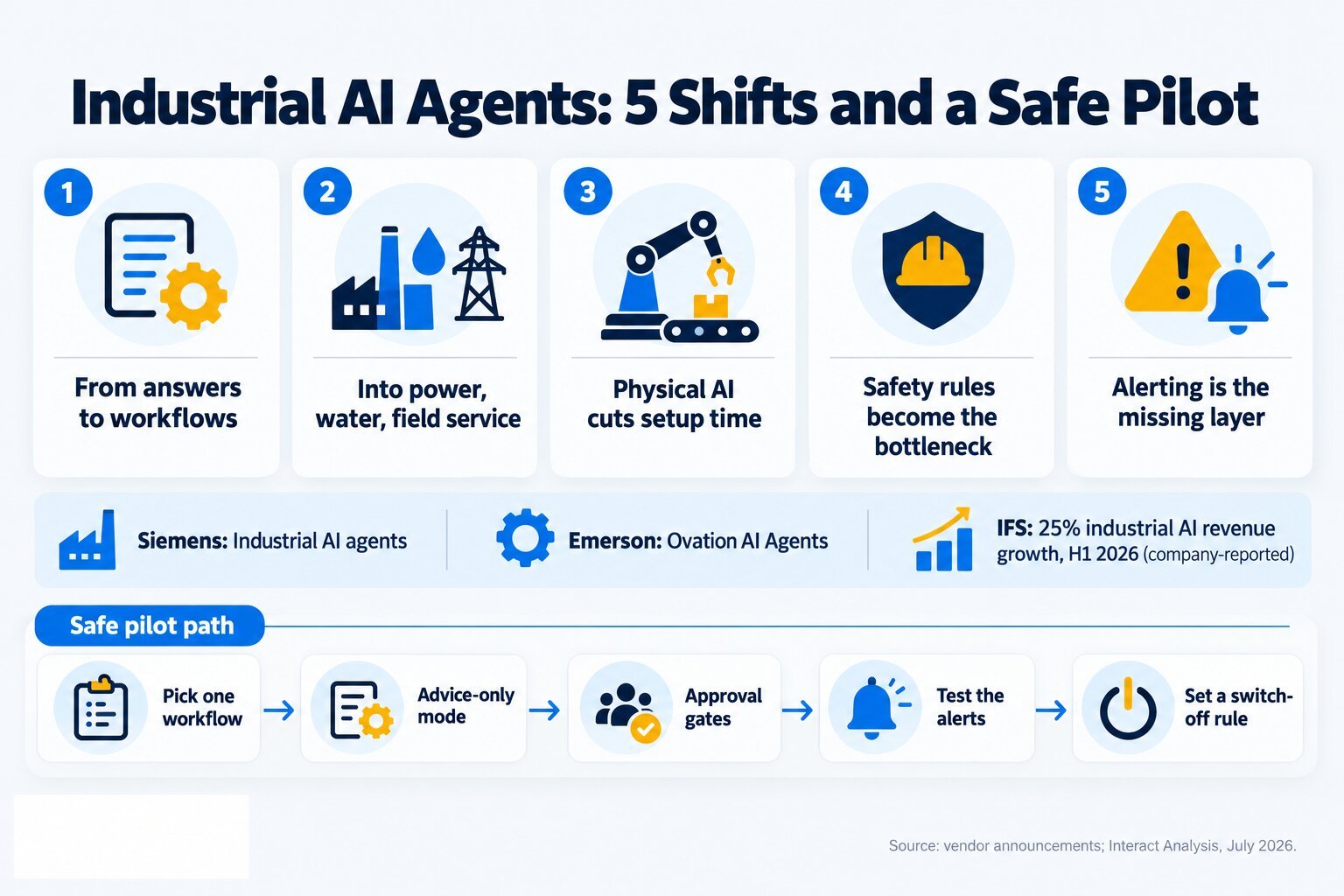
Siemens, Emerson and IFS have launched agent-style products. Siemens introduced Industrial AI agents at Automate 2025 in Detroit, and Emerson added Ovation AI Agents for power and water. IFS reported 25% year-on-year industrial AI revenue growth in H1 2026. All performance figures are company-reported.
| Vendor | What was announced | Where it fits | Read with care |
|---|---|---|---|
| Siemens | Industrial AI agents on its Industrial Copilot (Automate 2025) | Process and discrete manufacturing | Users pick the tasks. The 50% aim is Siemens’ own. |
| Emerson | Ovation AI Agents on Ovation Automation Platform 4.0 | Power and water | Shows agents moving beyond assembly lines. |
| IFS | Industrial AI, including fault prediction for field service | Field service, asset-heavy industries | The 25% growth is IFS-reported. |
The startup side is just as busy. The Business Perspective’s AI agent startup funding report for September 2026 headlines 56 record rounds, and Rise of Startups tracks founders.
If you sell into plants, reaching the engineer who runs the pilot is a job of its own. ARS B2B Social Bridge helps B2B technology teams reach verified decision-makers, for example through ARS TargetBridge account-based campaigns.
What are the 5 shifts industrial AI agents bring to factories?
Five things are changing. Agents move from answers to workflows, spread into power, water and field service, and cut set-up time through physical AI. Safety rules become the speed breaker, and alerting is the missing layer. Each shift has a catch.
Shift 1: From answers to workflows
Agents now chain steps: spot an anomaly, check the maintenance history, open a ticket. This works where the process is written down. It fails where the know-how sits in one senior engineer’s head.
Shift 2: Into power, water and field service
Emerson built Ovation AI Agents for power and water, while IFS aims at field service, where its tool predicts faults and cuts downtime.
Shift 3: Physical AI cuts set-up time
MarketScale reported in July 2026 that physical AI is squeezing year-long automation projects into months. RoboDK says its software cuts robotic machining set-up time by 40%, a vendor figure. Faster set-up does not mean faster safety approval.
Shift 4: Safety rules become the speed breaker
Suppliers are not equally ready for tighter robot safety standards.
Shift 5: Alerting is the missing layer
Most demos end at “the system found a fault”. Who reads it?
Why do safety rules slow down factory AI agents?
Because an agent that moves equipment needs the same safety proof as any other machine. A July 2026 Interact Analysis report on incoming industrial robot safety standards found supplier readiness varies. Ask each supplier for its certification status and timeline in writing before you sign.
At IoT Mail Bridge, we would start with an agent that only advises. It reads data and recommends, but a human presses the button. That is far easier to approve than one that moves machinery.
A robot set up in three months needs the same validation as one that took a year. Do not let a shorter schedule shorten your acceptance checks. Data handling matters too, as our piece on edge to cloud data security for IoT fleets shows.
Who reads the alert when industrial AI agents find a fault?
A person does, and that is where many demos stop. An agent that finds a fault but emails nobody who reads it has saved no time. You need throttling, escalation and delivery tracking so the right person sees the right message.
Think about the supervisor in our 2 am story. If the agent fires 200 alerts a night, he will mute all of them by Friday. If it fires none, the bearing burns anyway.
This last mile is the work we do at IoT Mail Bridge. Read our notes on a reliable SMTP relay built for IoT and M2M fleet alerts, and our guide to setting up email automation for industrial AI agents and IoT sensors. Whatever you buy, decide how the alert reaches your people before you switch anything on.
How do you start a safe pilot with industrial AI agents?
Pick one repetitive workflow and run the agent in advice-only mode for several weeks. Log every suggestion and compare it with what your team did. Only then allow small actions, each approved by a human. Test the alert path first.
- Choose one workflow with clear steps and a measurable cost, like downtime.
- Run in advice-only mode. Record every suggestion and what happened next.
- Add human approval for any action that changes equipment settings.
- Test alerts end to end, including when nobody reads them.
- Decide in advance when you will switch the agent off.
For site readiness, see our practical checklist for deploying industrial IoT sensors and the guide on cutting factory downtime with industrial IoT. IoT Insights Hub covers the device side.
What do critics say about industrial AI agents?
The careful view has three parts. The big numbers come from vendors, not independent trials. Safety readiness is uneven, per Interact Analysis, and an agent is only as good as its data. Supporters say agents free people from routine work.
What the careful voices say
- The numbers are self-reported. Siemens’ 50% aim, RoboDK’s 40% and IFS’s 25% growth all come from the companies themselves.
- Readiness is uneven. Interact Analysis found suppliers are not equally prepared for new robot safety standards.
- Data comes first. Our view: messy sensor data gives messy decisions.
What supporters say
- People get freed up. Siemens says agents handle routine processes so people can focus on “innovation, creativity, and complex problem-solving.”
Our view at IoT Mail Bridge: both camps are right. Industrial AI agents are real, but results depend on data quality and how tightly you limit the agent.
What are the most common questions about AI agents in factories?
People mostly ask what these agents are, who sells them, whether small plants can use them and whether the claims hold up. IoT Mail Bridge answers six common questions below, each tied to a named source or a clear limit.
Are industrial AI agents the same as robots?
No. Industrial AI agents are software that decides and acts on tasks, such as raising a work order or sending an alert. Robots are physical machines. An agent may direct a robot, but most work on information and workflows, so the safety checks differ.
Who makes industrial AI agents?
Siemens, Emerson and IFS have all announced agent-style industrial AI. Siemens introduced its Industrial AI agents at Automate 2025. Emerson added Ovation AI Agents for power and water. IFS reported 25% year-on-year industrial AI revenue growth in the first half of 2026.
Can small manufacturers use industrial AI agents?
Yes, if they have reliable sensor data and one clear workflow to automate. Start with a narrow use case such as maintenance alerts. Keep a person in the approval loop, and test for weeks before the agent controls any equipment.
Do industrial AI agents replace engineers?
Siemens says agents handle routine processes so people can focus on innovation, creativity and complex problem-solving. In practice, engineers still set the limits, review the actions and own the result. Treat the agent like a junior colleague who needs supervision.
Are the productivity numbers for industrial AI agents reliable?
Treat them as vendor claims. Siemens aims for up to 50% productivity gains and RoboDK says its software cuts robotic machining deployment time by 40%, but we found no independent trial data. Run your own pilot and measure downtime or cost before and after.
How should industrial AI agents send alerts to people?
Through a delivery path that throttles repeats, escalates unread messages and tracks delivery. Email is still the most common route to a supervisor. An SMTP relay built for device traffic stops one noisy sensor from flooding inboxes. Design this path before you switch the agent on.
What is the bottom line on industrial AI agents?
Industrial AI agents have moved from concept to product, but the proof sits in your plant, not in a press release. Start with one workflow, keep people in the loop and fix the alert path first. IoT Mail Bridge will keep tracking what ships.
Go back to that pump at 2 am. The agent did its job only if the supervisor got one clear message and the power to say yes or no.
Take the five shifts and pilot steps to your next plant meeting, pick one workflow, and measure it honestly. If industrial AI agents save you even one night of firefighting, the pilot has paid for itself.