
5 Proven Reasons NB-IoT Is the Future of Smart Connectivity
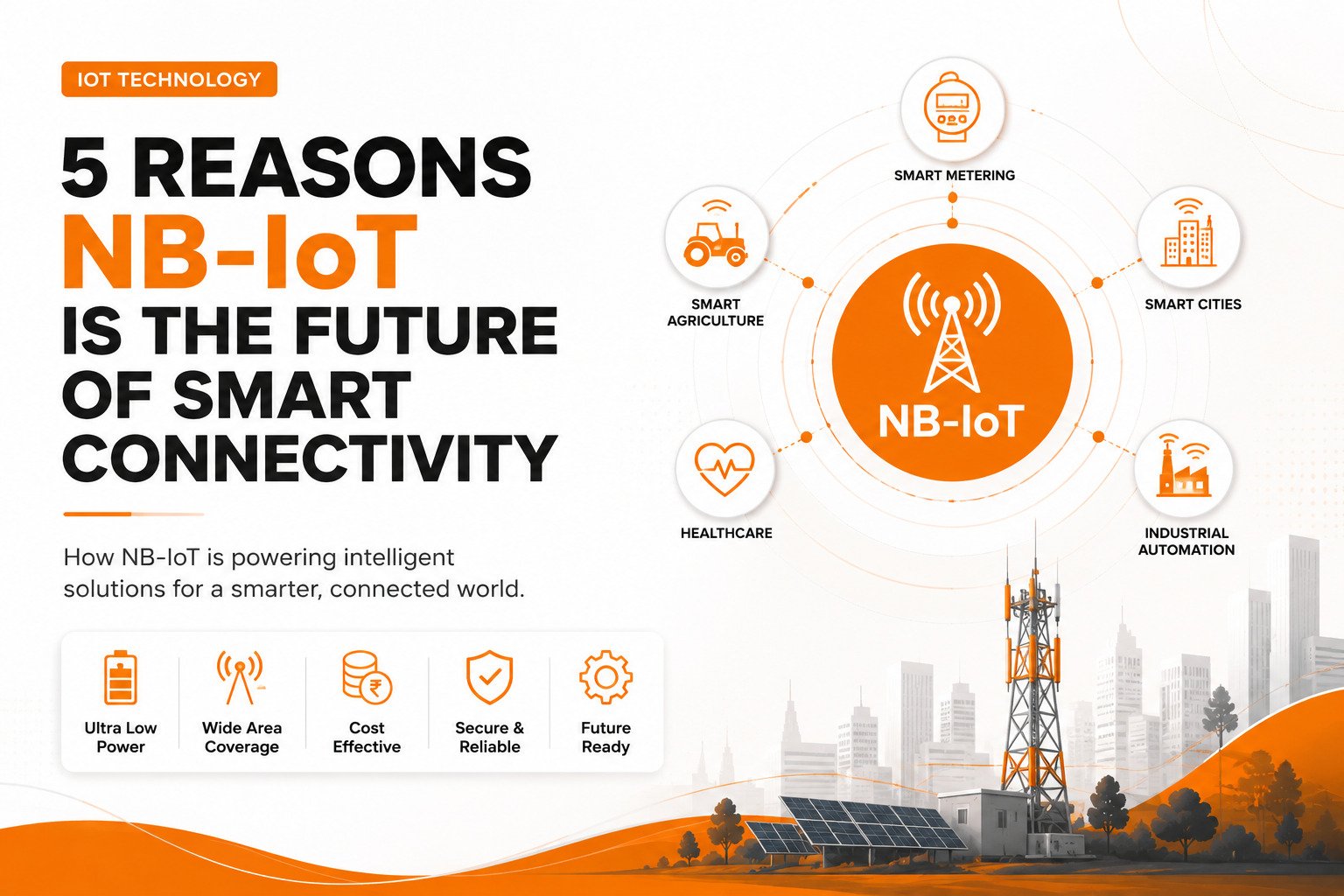
NB-IoT (Narrowband Internet of Things) is a low-power wide-area network protocol built for large-scale device deployments. It connects sensors over ranges up to 15 km on a single battery lasting up to 10 years, running on existing LTE and 5G infrastructure. Core applications include smart metering, smart cities, agriculture monitoring, cold-chain logistics, and industrial asset tracking.
Key Takeaways
- Narrowband IoT devices run for up to 10 years on one battery — the longest in any cellular standard.
- It penetrates deeper into buildings and underground than standard LTE — a 20 dB coverage advantage.
- Narrowband IoT runs on existing LTE and 5G towers — no new infrastructure investment required.
- A single cell supports 200,000+ connected devices per square kilometre for dense smart city rollouts.
- Licensed spectrum means guaranteed Quality of Service, not the shared-band risk of LoRaWAN or Sigfox.
What Exactly Is Narrowband IoT?
Narrowband Internet of Things (NB-IoT) is a licensed-spectrum LPWAN standard built by 3GPP to connect millions of low-data sensors over long distances on minimal power. It runs on existing LTE and 5G towers, covers ranges up to 15 km, and powers devices for up to a decade on a single battery.
Picture a water meter buried under a pavement in Mumbai, a soil sensor sitting in a wheat field in Punjab, or a cold-chain tracker sealed inside a pharmaceutical container. Each of these devices needs to send a handful of bytes every few hours — reliably, cheaply, and without anyone swapping batteries for a decade.
That is precisely the problem this technology was built to solve. Standardised under 3GPP Release 13, narrowband IoT is a licensed-spectrum LPWAN protocol that runs on existing LTE and 5G infrastructure. It trades raw speed for three things: extreme power efficiency, deep indoor penetration, and scalability across millions of devices.
With over 180 operators deployed across 70 countries and a chipset market projected to grow from $105 million in 2023 to $1.15 billion by 2030 (per GSMA Intelligence), this is not a niche experiment. At IoT Mail Bridge, we track this market closely — it is fast becoming the default fabric for large-scale wireless deployments worldwide.
How Narrowband IoT Works — The Simple Picture
Sensor Wakes
Device wakes from deep sleep to collect data
Narrowband Uplink
Sends tiny packet over 180 kHz licensed channel
LTE / 5G Tower
Existing cell tower receives — no new infra needed
Cloud Platform
Data routed to an IoT platform for processing
Device Sleeps
Returns to PSM sleep — battery saved for years
5 Proven Reasons NB-IoT Is the Future of Smart Connectivity
Narrowband IoT consistently outperforms competing LPWAN protocols for large-scale, static-device deployments because of five structural advantages: decade-long battery life, deep building penetration, no new infrastructure cost, support for 200,000+ devices per cell, and guaranteed Quality of Service on licensed spectrum.
There are dozens of wireless protocols competing for wireless device deployments — LoRaWAN, LTE-M, Sigfox, Zigbee, Wi-Fi HaLow. So why does narrowband IoT keep pulling ahead for large-scale, mission-critical rollouts? Here are five reasons that hold up under scrutiny.
Ultra-Low Power Consumption — Devices That Last a Decade
Narrowband IoT devices use Power Saving Mode (PSM) and extended Discontinuous Reception (eDRX) to spend the vast majority of their operating life in a near-zero power state. When a device only needs to report once an hour — say, a gas meter — it can survive on a standard battery for 10 years or longer.
Replacing batteries across thousands of deployed sensors in remote locations is expensive and logistically painful. It also introduces service gaps. Narrowband IoT essentially removes battery management as a concern for most static sensor deployments, which is why utilities love it.
⚡ Up to 10-year battery lifeDeep Indoor and Underground Penetration
This protocol achieves a 20 dB improvement in coverage gain over standard GPRS. In practical terms, that means signal reaching roughly 100 times further into obstructed environments — basements, underground parking, elevator shafts, and sub-surface utility tunnels are all covered reliably.
For smart metering — where meters are often inside buildings or underground vaults — this is the difference between a deployment that works and one that does not. No other LPWAN technology on licensed spectrum matches this penetration depth at equivalent power budgets.
📶 20 dB extra coverage gainRuns on Existing LTE and 5G Infrastructure
Most LPWAN technologies require dedicated base stations or a proprietary network overlay. Narrowband IoT does not. It was built into the 3GPP LTE standard and carried forward into 5G New Radio specifications, so it can run directly on spectrum already deployed by mobile operators via in-band or guard-band deployment.
For enterprises, this means no upfront network infrastructure investment. For operators, it means monetising existing spectrum with new device services. This is why over 180 operators worldwide now support this technology commercially — and why it is future-proof against 5G network upgrades from day one.
🏗️ No new infrastructure neededMassive Device Density — One Tower, Thousands of Sensors
This standard is specifically optimised for Massive Machine Type Communication (mMTC) — connecting enormous numbers of simple devices in a concentrated area. A single narrowband IoT cell can theoretically support over 200,000 connected devices per square kilometre.
This makes it the natural fit for smart city deployments: thousands of parking sensors, street lights, environmental monitors, and waste bins — all reporting to a single base station without congestion. No other LPWAN technology achieves this density on licensed spectrum with the same reliability guarantees at scale.
🏙️ 200K+ devices per sq kmLicensed Spectrum — Guaranteed Quality of Service
Unlike LoRaWAN and Sigfox — which operate on unlicensed ISM bands shared with other wireless devices — narrowband IoT uses licensed spectrum. This means guaranteed Quality of Service (QoS), predictable latency, and interference-free operation under regulatory protection.
For healthcare monitoring, industrial alarm systems, or utility infrastructure where missed packets have real consequences, this reliability difference is critical. The licensed-spectrum foundation, combined with built-in 3GPP mutual authentication and end-to-end encryption, makes it the enterprise-grade choice for mission-critical wireless infrastructure.
🔐 Licensed spectrum + 3GPP securityNot everyone agrees that narrowband IoT is the universal winner. Some analysts, particularly those cited in Ericsson’s 2025 Mobility Report, argue that LTE-M’s superior mobility support and lower latency make it a stronger long-term bet as IoT use cases become more dynamic — tracking moving assets, supporting voice alerts, and handling firmware-over-the-air updates more efficiently. For deployments involving vehicles or wearable devices, LTE-M still has a clear case. The honest answer is that the two technologies are complementary, not competitive — each is optimal for different device classes.
NB-IoT vs LTE-M vs LoRaWAN — Side-by-Side
Narrowband IoT leads on power efficiency and device density. LTE-M leads on mobility and latency. LoRaWAN leads on rural range and private deployment cost. The right choice depends entirely on whether your devices move and how often they transmit.
| Specification | NB-IoT | LTE-M (Cat-M1) | LoRaWAN |
|---|---|---|---|
| Spectrum type | Licensed | Licensed | Unlicensed ISM |
| Max throughput | 20 – 250 Kbps | ~300 Kbps | 0.3 – 50 Kbps |
| Urban range | Up to 10 km | Up to 10 km | Up to 5 km |
| Rural range | Up to 15 km | Up to 10 km | Up to 40 km |
| Battery life | Up to 10 years | 5 – 10 years | Up to 10 years |
| Latency | 1 – 10 seconds | 10 – 50 ms | Seconds – minutes |
| Mobility support | Limited | Strong | None |
| Infrastructure | Existing LTE / 5G | Existing LTE / 5G | Private / dedicated |
| Best for | Static sensors, metering, smart cities | Wearables, moving assets, voice | Private deployments, agriculture |
Where Is This Technology Being Used Today?
Narrowband IoT already powers smart metering, smart city infrastructure, cold-chain logistics, agriculture sensors, and healthcare wearables across more than 70 countries. In India, the Smart Cities Mission has accelerated adoption in Pune, Bengaluru, and Surat for waste management, water monitoring, and public lighting.
This wireless standard is not a technology in search of a problem. It already powers real infrastructure across multiple verticals.
Globally, utility companies lead adoption. Smart metering accounts for the largest share of deployments because meters fit the technology’s sweet spot perfectly — they are static, send small amounts of data infrequently, are often in basements or underground vaults, and battery replacement is extremely costly at scale.
In India, the Smart Cities Mission has accelerated narrowband IoT-based infrastructure across cities like Pune, Bengaluru, and Surat — with deployments covering solid waste management, water distribution monitoring, and public lighting control. If you are building for smart city infrastructure in the Indian context, this technology is increasingly the default connectivity choice for static sensor networks.
At IoT Mail Bridge, we have tracked this adoption curve closely. The pattern is consistent: once a utility or municipality deploys narrowband IoT for one application — usually water metering — they expand to additional use cases within 18 months because the same network infrastructure serves all of them.
Frequently Asked Questions
The Takeaway
Narrowband IoT is not trying to replace every wireless technology. It is not designed for your 4K security camera or high-speed industrial robot. What it does — connecting millions of low-data, battery-powered sensors reliably over wide areas on existing infrastructure — it does better than anything else currently available.
For anyone building or planning deployments in smart utilities, smart cities, agriculture, or industrial monitoring, this protocol represents the most cost-effective and power-efficient path to large-scale wireless connectivity. As it integrates deeper into 5G networks and chipset costs continue to fall, its adoption will only accelerate through the rest of this decade.
The question is no longer whether it will scale at a global level. It already has. The question is whether your organisation is positioned to take advantage of it — before competitors who have already deployed get too far ahead.
At IoT Mail Bridge, we will keep tracking the deployment numbers, operator announcements, and chipset cost curves. Bookmark this page and follow our coverage for ongoing updates.